


By Okoi Obono-Obla
Historical Debate on the Selection of Obol Lopon of Ugep
In response to my post of 13 May 2026 titled “The Role of Okpan in the Selection of Obol Lopon of Ugep”, Mr. Julius Inah argued that the emergence of Obol Michael Obeten as Obol Lopon was primarily the product of political intrigues of the time. He suggested that the influence of the NCNC and Action Group, particularly through figures such as Chief Ubi Ofem and Dr. Okoi Arikpo, shaped the throne’s succession. According to him, while the Kingmakers had nominated Obol Pius of the Leboljime maternal family, Obol Michael Obeten’s father’s political affiliations with NCNC and ties to Ubi Ofem facilitated his rise.
Mr. Inah further emphasized that politics, rather than kinship, determined the succession, citing historical precedents where an Idomi man once became Obol Lopon of Ugep, and conversely, a Ugep man became Obol Lopon of Idomi. He concluded that the present dispensation in Idomi reflects convenience and stability, suggesting that other communities might adopt similar models.
Contrary to this position, I maintain that Obol Enang of Ugep was chosen as Obol Lopon even though he was not a member of the royal Leboljime family. His selection underscores the flexibility of Yakurr traditional governance, where kinship structures—particularly the institution of Okpan—play a decisive role alongside political considerations.

The Concept of Okpan in Yakurr Philosophy
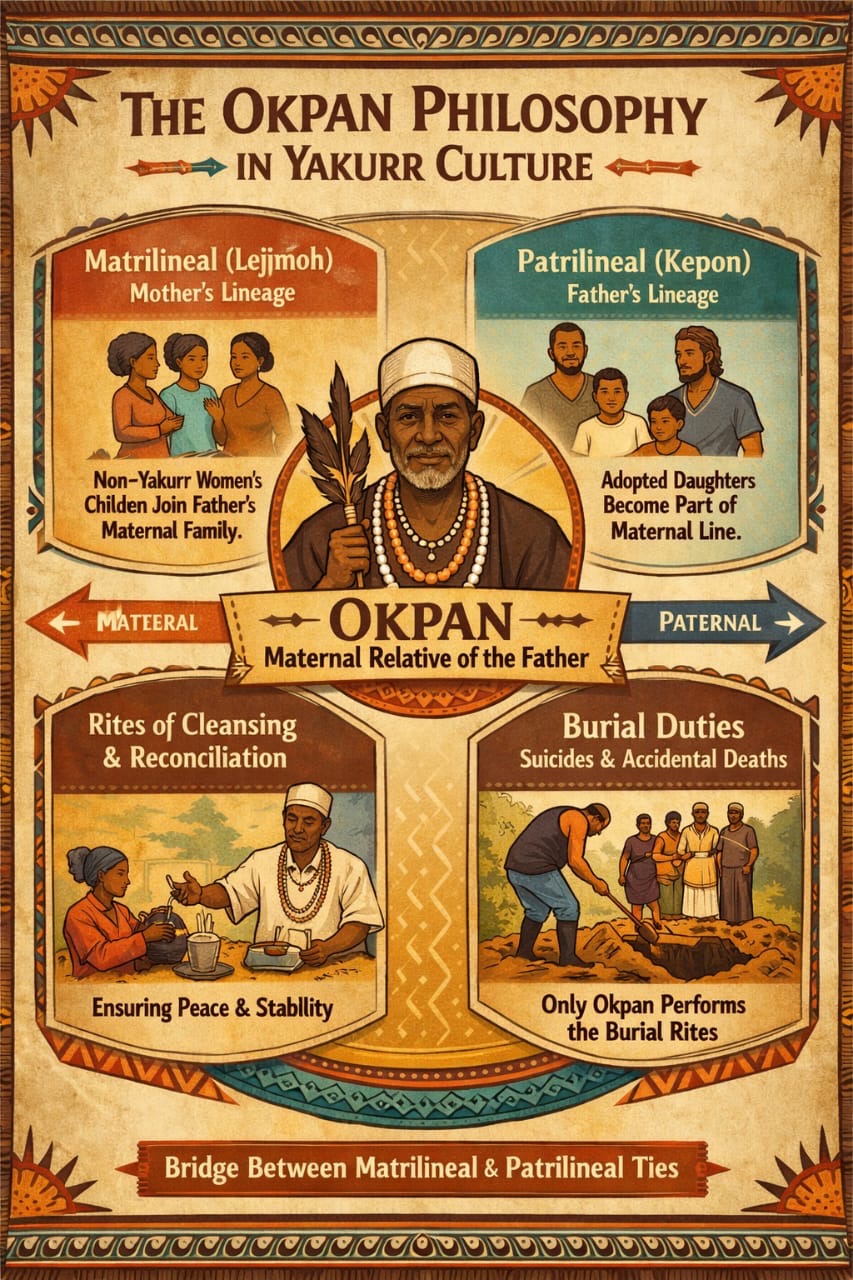
The institution of Okpan (Peacemaker or Appeaser) is central to Yakurr kinship philosophy. It exists as a mediating structure between matrilineality (Lejimoh) and patrilineality (Kepon).
The Okpan is defined as a maternal relative of one’s father. Within Yakurr matrilineality, a child does not belong to the same maternity as his father, except in cases where the child’s mother belongs to the same maternity as the father. This exception occurs in two ways:
– When a man marries a non-Yakurr woman, the children of that union automatically become members of the man’s maternal family.
– When a woman has no female children, she may encourage her son to marry a non-Yakurr woman so that the children of that union become members of his maternity.
Historically, a man could adopt a female for himself or his sister, and such an adoptee would automatically become a member of his maternal family, enjoying all rights and privileges of that lineage.
Thus, the Okpan stands between matrilineal and patrilineal ties. He is a mediator, reconciler, and appeaser, expected to protect the interests of his father’s maternal relatives. If misfortune befalls them, the Okpan is responsible for cleansing the land through traditional rites.
In cases of accidental death or suicide involving his father’s maternal relatives, the Okpan assumes the role of undertaker, ensuring proper burial. Neither the deceased’s maternal nor paternal family members are permitted to perform burial rites; only the Okpan (plural: Yakpanakpana) may do so. The families may, however, participate in memorial ceremonies after the Yakpanakpana have completed the appeasement rites.
Conclusion:
The historical debate over the selection of Obol Lopon of Ugep illustrates the interplay between politics and kinship in Yakurr society. While political forces undoubtedly influenced succession at certain times, the institution of Okpan demonstrates that Yakurr traditional governance is deeply rooted in cultural structures of mediation, reconciliation, and balance. The Okpan ensures continuity between matrilineal and patrilineal obligations, safeguarding peace and stability within the community.
Tags:
Okpan











This has been the position from time past and as far as tradition and custom is concern in kaekaa (kekor). These structural institutions can face some sorts of variations overtime by way of modernity and pressure for westernisation and maybe good representation in leadership. Again, from the highlights about the place of maternal kinship or kith, custom and tradition permits marrying into one’s distant maternal family; yet with modernity, there is recorded marriages of distant paternal relations, though with certain rites being performed here and there; and such rites likely to fade with non-passing or transmission of records of such practices to the next generation.