Ave Tinubu, morituri salutamus te
By Suyi Ayodele
(Published in the Nigerian Tribune on Tuesday, February 24, 2026)
https://tribuneonlineng.com/ave-tinubu-morituri-salutamus-te/

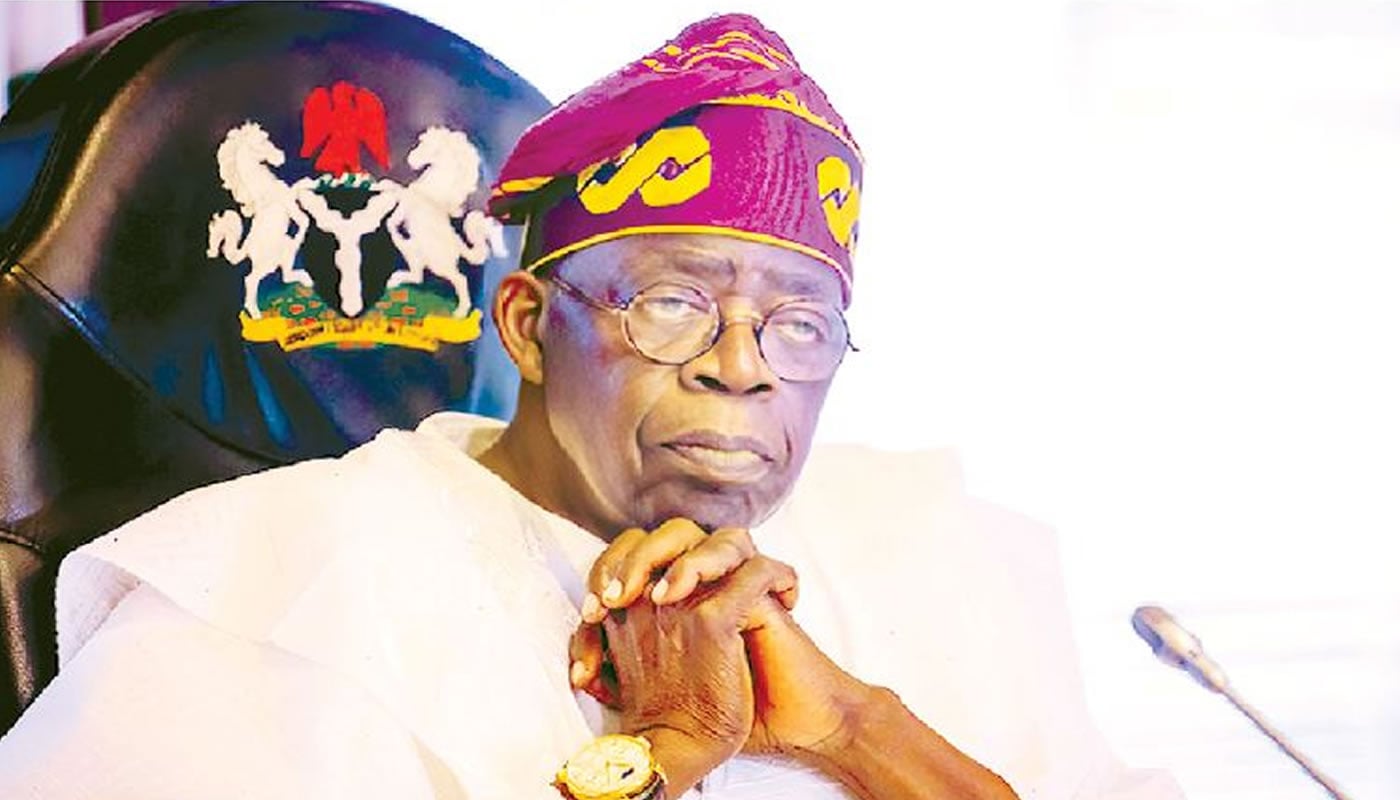
President Bola Ahmed Tinubu proved critics wrong last Wednesday. Those who hold the belief that the President is old, tired and physically inactive were damned when, with the speed of light, Tinubu appended his signature to the controversial Amended Electoral Bill 2026. By the stroke of his presidential pen, the strong man of the moment has shut down all protests and agitations against the controversial law.
It is not funny. The National Assembly led by the whippy Senator Godswill Akpabio passed the Bill on Tuesday, February 17, 2026. Only 12 senators voted against the Bill. The rest of the yes-men senators endorsed the Bill. In the House of Representatives, opposition lawmakers left the chamber, singing and denouncing the ruling All Progressives Congress (APC) majority.
At the end of the day, our novel democracy was at play. The minority had their voice, and the majority had their way. Then came Tinubu and his speed. Less than 24 hours after our legislators threw us back to the Stone Age of ballot snatching and election results doctoring, President Tinubu said yes and gave life and blood to the Bill!
I don’t speak Latin. I did not take any elective courses in Classics. I stumbled on the Latin phrase morituri salutamus te, during an interaction with a retired octogenarian broadcaster with the British Broadcasting Corporation (BBC), Tony Abolo. Ose (meaning an elder in Urhobo Language) Abolo is a delight any day, anytime.
I have yet to come across an avid reader like the 83-year-old journalist; he turned exactly 83 on Saturday. Ose Abolo does not read; he studies his books. That is not even totally correct! Abolo edits all his books. I take a bet that when it is time for him to transition, he may do so holding a book. I say this because while sitting at his table with his favourite Heineken beer and a small bottle of groundnuts, Abolo holds a book, a pen and he talks to you while stealing a glance at a page he has marked, underlined and made several footnotes!
I never miss any opportunity to engage him. I had that chance last Wednesday evening. A group of men were gloating over the speed with which President Tinubu signed the Amended Electoral Bill 2026 into law. The guys were happy because, according to them, Tinubu had given the opposition “another master stroke.”
Ose Abolo took his leave of the group and held my hand, drawing me aside. He asked: “Have you ever heard the Latin phrase: morituri salutamus te” I answered in the negative. He laughed and said: “It means we who are about to die salute you.” The old man tore a piece of paper, wrote the words and asked me to read more about it, adding: “You will find it funny and sad at the same time”, and looking at the direction of the discussants, he added: “They are over there; those who are about to die.”
I went in search of the phrase. Morituri salutamus te, has different variants. The one I consider most fascinating is Avē Imperātor, moritūrī tē salūtant. It means “Hail, Emperor, those who are about to die salute you.” One account of the phrase traces it to Claudius, the fourth Roman Emperor of the Julio-Claudian Dynasty, who ruled between AD 41 and AD 54. The account says that Claudius formed the habit of assembling gladiators, who are mostly condemned criminals, armed them with swords and ordered them to fight lions at the pit section of the Roman Amphitheatre.
While Emperor Claudius sits in royal attire, surrounded by his courtiers and other invited guests, the helpless gladiators are led into the pit. And before the lions are released, they raise their swords and in unison, raise their voices, saying: Avē Imperātor, moritūrī tē salūtant. Then the fight for survival against the lions will ensue. The Emperor watches from his throne in delight as those who earlier hailed him die one after the other, devoured by the hungry lions unleashed on them!
Harry J. Leon of the University of Texas, USA, in a 1939 paper titled; “Morituri Te Salutamus” published in the Transactions of the American Philological Association (70: 45–50. Retrieved 2012-10-11), observed that “the salute had become widely represented and embellished in numerous works dealing with Roman antiquities, so that it has become one of the best known and most often cited of Roman customs.”
The Irish playwright and literary critic, George Bernard Shaw (July 26, 1856-November 2, 1950), popularised the ‘salute’ in his 1912 play, titled: “Androcles and the Lion”, where, just before the condemned Christians face the lions, they chorus: “Hail, Caesar! those about to die salute thee”, with the Emperor responding, “Good morrow, friends”.
The debate has been on since then. Many of Tinubu’s fans are out in merriment. Their singsong is: ‘did we not tell you that the President is a master strategist?’ I have heard many of such clichés. Thanks to Ose Abolo, who led me to study that Roman fatalistic phrase, which denotes the acceptance of defeat! Each time anyone gloats about the ‘political sagacity’ demonstrated by Tinubu in signing the Amended Electoral Bill 2026 into law, I recourse to the Latin phrase and its psychological implications.
The reality of the whole scenario is that we are all victims. And if the truth must be said, the greatest victims are those who know the truth but choose to stand with party loyalty at the expense of collective willpower to fight for that which is just and equitable. Those are the real ones who are about to die but will still hail the one sending them to their early graves.
The major argument against the real-time electronic transmission of election results is the idea of non-availability of networks in some rural areas. Another argument against the innovation is the issue of network failure in the urban centres. Nobody in his right senses will declare the two reasons as invalid. That is not even the point that many Nigerians who are in support of real-time electronic transfer of election results are putting forward.
It is very unfortunate that in the year 2026, Nigeria is still debating the issue of electronic transfer of election results. It is sadder to even note that the majority of those who tenaciously oppose the idea are those, who, in the comfort of their bedrooms, electronically transfer millions of naira from their phones to beneficiaries across the globe! The only time these fellas remember that there could be network failure is when it comes to elections and their results.
I feel personally sad that when Nigerians should be talking about electronic voting, we are still tied down by the debate of availability of a network or network failure. I have been asking what happened to the rural telephony efforts of the various telecommunication outfits in the country. I say this because as far back as 2006, I led a team of Mobile Publicity Unit (MPU) on a Road Telemarketing Campaign (RTC), when the indigenous telecommunications company, Globacom, launched its We Live Where You Live (WLWYL), rural telephony initiative.
The entire country was divided into six. Each MPU covered six states. My team was assigned the South-East. From Igbere to Akwa Etti, from Uturu to Ohafia, we were in the villages selling the Globacom Subscriber Identity Modules, otherwise known as SIM cards. In communities where there was no network, each team wrote a report and the Roll Out Department moved in to either establish a Base Transceiver Station (BTS), or reinforce the closest BTS for optimal network coverage.
It was for this reason that the company deployed mostly 75-metre towers with seven-kilometre radius coverage. The year 2006 is some 20 years ago. Today, the fear of non-availability of networks in rural areas has denied Nigerians the opportunity of having their votes counted, transmitted and guaranteed as true reflection of their choices!
Like many of the would-be ‘beneficiaries’ of the new electoral laws are wont to argue, ‘those who don’t like the new law can go to court’, I think Nigerians and their government need to do more. If indeed, 26 years after the coming of the mobile telecommunications system, there are still some rural areas that are not covered, the regulatory agency, the Nigerian Communications Commission (NCC), must rise up and do the needful. The various operators must be mandated to deploy their facilities in the rural areas. No Nigerian should be allowed to remain in the Stone Age. It is an aberration that communities still exist without a network as canvassed by the wise men and women in the National Assembly!
Beyond monitoring the quality of the network and the consumer-friendliness of their tariffs, telecommunications operators must be made to realise that rural telephony is not a luxury but a basic necessity of life that no Nigerian should be denied. Whatever the efforts telecommunications operators like Globacom might have made 20 years ago should be redoubled. Our politicians should not be allowed to behave like the proverbial dirty woman who finds an alibi in the death of her husband to say that she is so devastated, that for three days, she could not have her bath as if it is a regular personal hygiene she engages in (Obun rí ikú oko di òrò mò; ó ní láti ojó tí oko òun ti kú, òun ò bu omi sórí).
Beyond the above, an average Nigerian knew from day one that the Akpabio-led National Assembly would pass the electoral bill. On this page on February, 10, 2026, I wrote, under the title: “The senate coup against Nigerians”, thus: “If the Electoral Act 2020 (Repeal and R-enactment) Amended Bill 2026 passed by the Godswill Akpabio-led senate is allowed to be the guiding laws and principles for the 2027 general elections, Nigerians can kiss democracy goodbye. With the new bill as passed by the senate, everything called credibility, fairness, decency and morality, is gone and gone forever!” Nothing has changed; not even the attempt by the Presidency to deodorise the new law as one that will make Nigerians “to see democracy flourish”, notwithstanding.
Every Nigerian is a victim of the new law irrespective of their political affiliations. Even those sitting on the fence, who have remained largely apolitical, will have their own fair share of the pains. It is not the new law that is faulty. Everything about our electoral system is an aberration. The President appoints the Chairman of the Independent National Electoral Commission (INEC). That makes the Commission dependent on the appointing authority, which also funds it. A pliable National Assembly led by Akpabio, approves the appointment. We keep moving from one dirt to another. All INEC National Commissioners and Resident Electoral Commissioners (RECs) are appointed by the same President. These are the men and women who will supervise the elections.
In case of any dispute, the aggrieved parties go to the courts presided over by judges and justices appointed either by the President or the governors. We all know the controversies that had trailed the activities and judicial pronouncements of our judges and justices in the recent past. This is one of the reasons why Nigerians have lost confidence in the entire system. Again, this is the reason why those in power today are quick to ask the rest of us to ‘go to court’. They know that the courts are no longer courts!
The only hope of credibility in our electoral system is real-time electronic transmission of election results. But that, President Tinubu and his cohorts in the National Assembly have thrown over the bar, with the President asking Nigerians to “…question our broadband capability. How technically sound are we today? How technically sound will we be tomorrow in answering the call, whether in real time or not?”
While we will do as the President demanded by asking those concerned to strengthen the nation’s “broadband capability”, we shall also ask Tinubu to attend to other issues, especially insecurity, affecting Nigerians with the same speed and timeliness he attended to the new electoral law. We shall be asking the President to treat other matters with the same alacrity so that those who are about to die under the excruciating pains of the economic failures of his administration will have the strength to salute him. For now, on the new feat of signing Amended Electoral Act 2026 into law, we say: Ave Tinubu, morituri salutamus te.