


By Okoi Obono-Obla
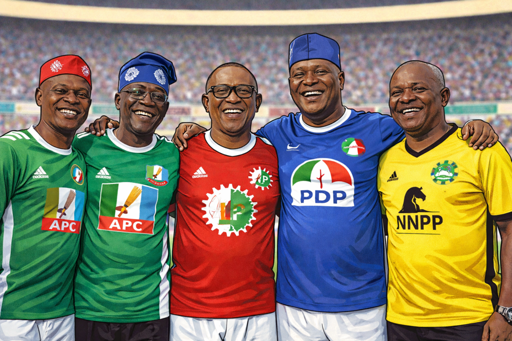
The profiles of those who boast that, if given opportunity by the Nigerian electorate in 2027, they would deliver dazzling leadership, are impressive on paper. To the uninitiated or uninformed, their grandstanding and gallery-playing may appear convincing, as typical politicians soliciting support often do. Yet, these individuals have been given several opportunities in government to showcase their credentials, but their performance has been abysmally low and unimpressive.
They remain obsessed with power, packaging themselves for another bite at the national cherry. In my previous essay titled The Unbroken Circle of Power: Nigeria’s Political Titans, published by CharAfrik.com on 9 April 2026, I profiled some of the leaders of this so-called coalition. The very use of the word “coalition” is misplaced in Nigeria’s presidential system of government. Coalition is synonymous with parliamentary systems, which Nigeria discarded in 1979—more than 45 years ago.
Peter Obi was a close adviser or worked with the government of General Sani Abacha (1993–1998), during a tumultuous period when agitation for military withdrawal grew stronger as dictatorship became anachronistic. In 2006, he won his election petition, pursued resolutely from the Election Tribunal to the Supreme Court, overturning the declaration of Dr. Chris Ngige of the PDP as Governor of Anambra State. Obi was declared Governor under the platform of the All Progressives Grand Alliance (APGA) and served until 2014.
Many expected him, as a political juggernaut from the South East, to build APGA into a formidable regional party and use it as a springboard into national politics, much like President Bola Ahmed Tinubu did with the defunct Action Congress of Nigeria. Instead, Obi defected to the PDP, became Special Adviser on Economic Matters to President Goodluck Jonathan, and later Atiku Abubakar’s running mate in the 2019 presidential election. After losing the PDP presidential ticket in 2022, he defected to the Labour Party, campaigned as a conservative despite the party’s socialist leanings, and promised to withdraw subsidies and deregulate the currency. Though he made impressive gains among young voters, the Labour Party soon fragmented into irreconcilable factions, which he failed to resolve. Ironically, he has now defected again—this time to the fractious ADC—joining leaders he once derided as patrons of corruption. Obi has been in government since 1995, with ample opportunity to showcase leadership, yet whether pundits score him highly remains controversial.
Another leader of the coalition is Rt. Honourable Aminu Tambuwal of Sokoto State. He was elected into the House of Representatives, serving three terms, and became Speaker in 2011 with the support of opposition parties despite PDP’s resistance. In 2015, he was elected Governor of Sokoto State, serving until 2023. Pundits view his tenure as uneventful, dismal, and uninspiring. He was elected Senator in 2023 and has since defected to the ADC. Tambuwal has been consistent in government at the highest level since 2003, yet his record raises doubts about his capacity to deliver transformation.
Conclusion:
Can Nigerians trust these pro-establishment politicians—men who have long been at the vortex of power, entrusted with great responsibility, yet failed to use it maximally to transform the nation? Their recycled ambitions suggest not renewal, but repetition. As 2027 approaches, the electorate must weigh not the dazzling profiles, but the unimpressive legacies of those who seek another chance at power.











Leave a comment