
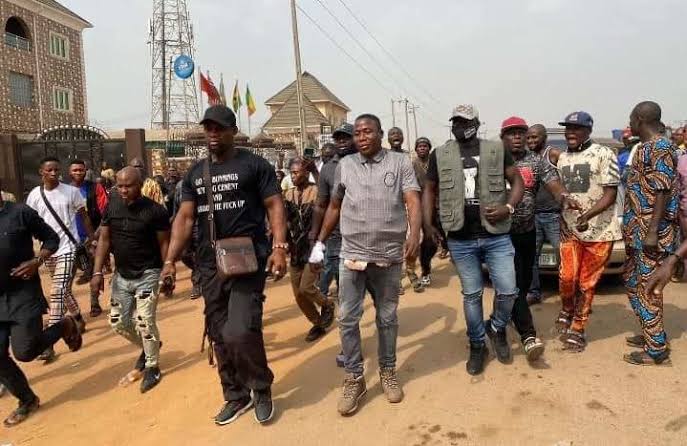

Political correctness often arrives dressed as civility, but in Nigeria’s charged public sphere it frequently functions as a quiet instrument of power that decides who may speak, who must endure and which anger counts. Coincidentally, the foregoing submission is visibly relevant within the context of recent uproar that greeted the remarks attributed to Sunday Igboho asking non-Yorubas not to campaign in Yorubaland if they continued to prevent President Tinubu in their regions too. The uproars have framed Igboho statement as unacceptable provocation but their stand also reveals how swiftly certain voices are condemned, while other forms of hostility are normalized or quietly excused.
As Nigeria moves toward the 2027 general elections, familiar fractures of identity, loyalty, and belonging are once again surfacing. The assumption that political tensions would cool after the last electoral cycle has not materialised. Instead, new configurations of antagonism have emerged, most visibly in the divide between the Obidient movement and the “Ẹmilokan” groups. What began as electoral preference has hardened into political identity, and, in some troubling instances, hostility.
Yet, the more revealing story is not simply that division exists, but how this unboxed division is interpreted and policed.
Groups such as the City Boys Movement which comprised largely of Igbo supporters aligned with the “Ẹmilokan” political group, have unsettled rigid assumptions about ethnic loyalty in Nigerian politics. Their positioning have disrupted the simplistic mapping of political allegiance onto ethnic identity. Ideally, this should be read as democratic maturity, and also a sign that citizens can act beyond inherited categories. Instead, their stance has attracted suspicion, and attacks on their properties as well as calls to boycott their businesses thereby exposing how deeply entrenched expectations of ethnic conformity remain.
However, it must be out on record that this reaction signals something deeper. Political choices that defy ethnic expectations are often treated not as legitimate expressions of agency, but as betrayal. In that sense, the backlash is not merely political but epistemic. It challenges the very frameworks through which Nigerians interpret belonging and loyalty.
It is within this broader context that the assertion that “Yorubas are “ọmọlúàbí” must be revisited.
Rooted in a rich ethical tradition, ọmọlúàbí signifies dignity, restraint, responsibility and a commitment to social harmony. It is a moral philosophy that privileges civility over chaos and dialogue over confrontation. Historically, it has been a source of cultural pride and social order. But in the present political climate, this ethical ideal is undergoing a subtle but consequential transformation.
It is being commodified.
What was once a moral disposition is increasingly being recast as a political expectation which is an obligation to endure, to absorb and to remain measured even in the face of provocation. In this reframing, ọmọlúàbí is no longer simply an ethical ideal; it becomes a regulatory norm.
To.me, therein lies the danger.
Within the Yoruba socio-political space, certain elite voices have assumed the role of moral gatekeepers. Invoking the language of civility and political maturity, they are quick to condemn any form of reciprocal rhetoric, often dismissed as “threat for threat”, as irresponsible or rabble-rousing. In doing so, they establish a hierarchy in which restraint is valorized, but assertion is delegitimized.
But this raises difficult questions. Why is restraint demanded asymmetrically? Why are provocations tolerated, even normalized, while responses are swiftly condemned? At what point does the insistence on civility become a mechanism for silencing legitimate expressions of grievance?
Political correctness, as I used it in this context, is not neutral. It becomes a tool, disciplining response while leaving provocation insufficiently interrogated. It creates the illusion of moral high ground while subtly redistributing power: determining who must endure and who is permitted to react.
To be sure, this is not an argument against ọmọlúàbí. Far from it. The ethical foundation it provides remains invaluable. But peace must not be mistaken for passivity, and civility must not become a pretext for suppressing dignity.
When accommodation becomes endless, it risks turning virtue into vulnerability. When restraint is selectively imposed, it risks becoming complicity. And when political correctness is deployed without reflexivity, it risks masking the very inequalities it claims to moderate.
As 2027 approaches, Nigerians must confront not only the visible fractures of ethnicity and political allegiance, but also the quieter mechanisms through which discourse is controlled. For it is often in these subtle spaces, in what is discouraged, condemned or left unsaid, that power does its most effective work.
To insist that Yorubas are *ọmọlúàbí* without interrogating how that identity is being mobilized in contemporary politics is to risk mistaking accommodation for virtue and silence for strength.
A kì í fi ìfaradà ṣe ẹrú.1i
Mo wi t’emi o.
Ire o.














Leave a comment