
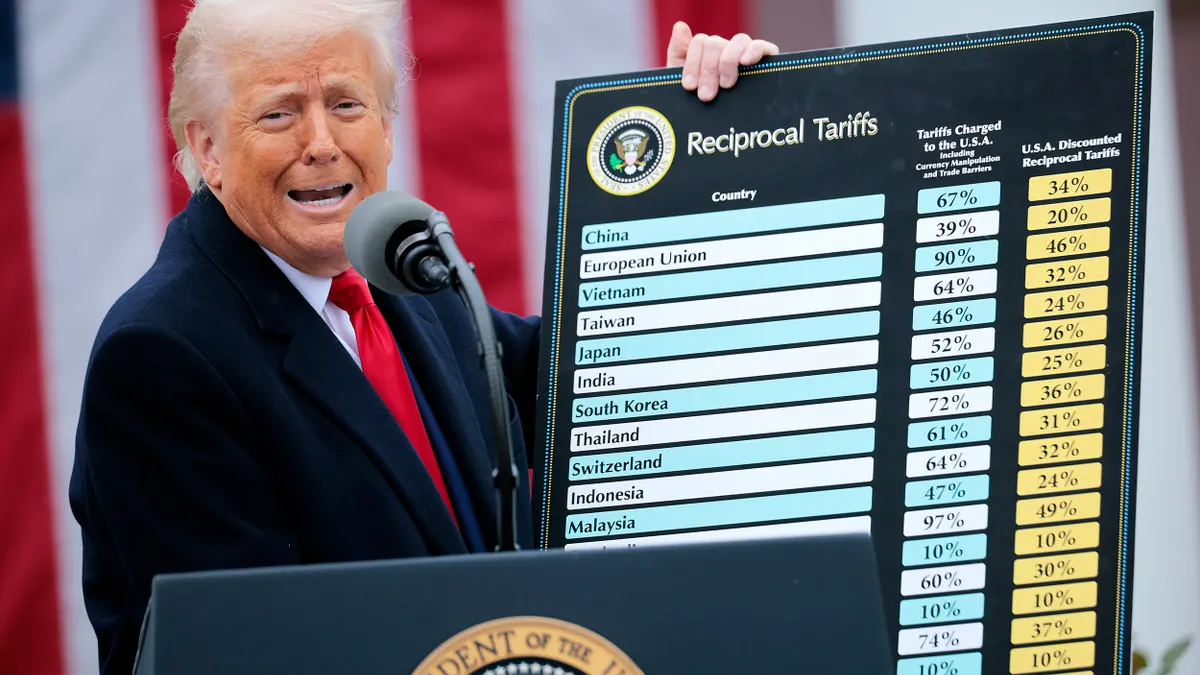

No Taxation by Decree: When Tariffs Slam into Constitutional Reality
By LaBode Obanor
One year ago, Trump’s Liberation Day was billed as a bold rupture from economic orthodoxy, a declaration of American economic independence, designed to shatter trade imbalances and energize domestic production. In practice, however, it was something else: a massive sweep of unilateral tariff power, rolled out under the guise of emergency authority and justified by a broad reading of presidential power. It was reckless then, and it is unconstitutional now.
On February 20, 2026, the U.S. Supreme Court struck down the core of the Liberation Day tariff regime with a 6-3 decision, including two right-leaning justices appointed by President Trump, holding that the president lacked statutory authority to impose sweeping global tariffs under the International Emergency Economic Powers Act (IEEPA). The court’s majority, led by Chief Justice Roberts, made plain that broad tariff powers are the domain of Congress, not the executive. The Constitution vests in Congress the exclusive authority to “lay and collect Taxes, Duties, Imposts and Excises.” The emergency law invoked by the administration simply did not confer the power to impose vast duties unbounded in scope, amount, or duration.
This decision is a constitutional rebuke. The original Liberation Day narrative relied on an expansionist reading of executive fiat, imagining a president who could declare “economic emergency” at will and subordinate statutory limits to political ambitions. The Supreme Court slapped him down, closed that loophole, and reaffirmed that even the most dramatic executive policy cannot override the separation of powers encoded in Article I.
The economic ripple is now shifting into legal tidal forces. Estimates suggest more than $175 billion in collected tariff revenue could be subject to refund claims once lower courts sort out the aftermath. Businesses and importers are actively seeking restitution, contending that duties collected under an unconstitutional regime should be refunded along with interest. States such as Illinois and California are sending invoices to the White House, demanding refunds for tariffs paid by their residents. Their claims are valid.
The political aftermath has been combustible. The president’s defenders cast the decision as judicial overreach; critics applaud the Court for curbing executive excess. Trump himself responded combatively, calling the decision “a disgrace,” including unleashing personal insults on the justices who voted to claw back this power grab. He swiftly pivoted to a new 10% global tariff under the Trade Act of 1974, then ratcheted it up to 15% under the same act, later signaling further increases and investigations under alternative statutes intended to reproduce the old Liberation Day effect through different legal boxes.
Nevertheless, the constitutional edge remains: the Court’s ruling has reaffirmed that no president may unilaterally rewrite trade policy under broad emergency powers. By forcing the executive branch to retreat to specific statutory pathways, the decision reshapes the terrain of U.S. trade policy and confirms a core premise of last year’s critique: that tariffs imposed as political theater, without firm legal grounding, are neither liberation nor strategy, but simply brazen presidential overreach.
This Supreme Court decision carries deeper significance than trade policy alone. It arrives after a term in which this right-leaning Court has handed the president substantial victories, including rulings that expand executive discretion and narrow avenues of accountability. The pattern has been unmistakable in the last 12 months. Presidential power has widened dramatically, and institutional guardrails have thinned significantly.
This case was different.
Here, the justices confronted a question that sits at the center of the American experiment, formed some 100 years ago: whether emergency language can be stretched until it becomes a permanent grant of unilateral authority. Whether a president may simply declare a crisis and assume powers the Constitution assigns elsewhere. The Court said no.
For years, critics have warned of the gradual erosion of the American democratic ideal, driven by the steady normalization of executive overreach. The revolution that birthed this republic was fought precisely against concentrated, unaccountable authority.
Against a sovereign who could tax by decree. The rhetoric of strength often drifts toward monarchy. The language of emergency easily becomes the language of permanence. The temptation to act as if electoral victory confers royal discretion is not new in history. What matters is whether institutions resist it.
In this instance, they did.
The Court’s ruling signals that there remains a constitutional line and that at least some members of this Court are unwilling to let it dissolve entirely. That fact alone tempers the darker forecast.
My original critique described Liberation Day as a tantrum masquerading as a strategy. The Supreme Court has now reframed it as something even more serious: an unlawful attempt to redraw the balance of powers through emergency improvisation. However, there is a deeper assessment and examination we must confront. A test at our institutions.
Would the judiciary continue expanding executive reach without pause? Or would it arrest the drift before emergency power hardened into habit? Would it allow the continued erosion of the country’s established canon? Or would it intervene to halt this precipitous fall of our democracy?
In this case, the answer provides a cautious kind of hope.
America is strained. Polarized. Bruised. Yet it is not yet post-constitutional. The architecture still stands. The line still holds.The revolution was fought to prevent rule by decree.
That principle, at least for now, survives. And that means the republic, though tested, is not yet surrendered.
If Liberation Day was meant to be a bold break from global trade norms, the Supreme Court has rendered it instead a lesson in constitutional limits. The damage done in markets and supply networks is not erased, but the precedent is clear: no policy, however urgent it feels to its authors, stands above the law. In the battle between executive impulse and constitutional structure, the law ultimately prevailed.














Leave a comment