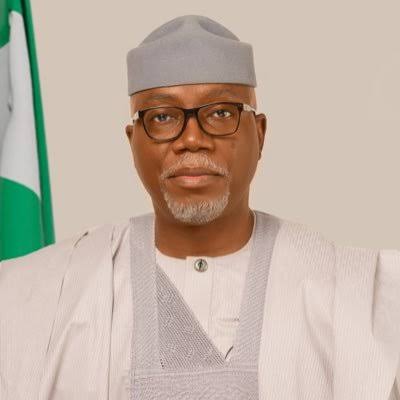



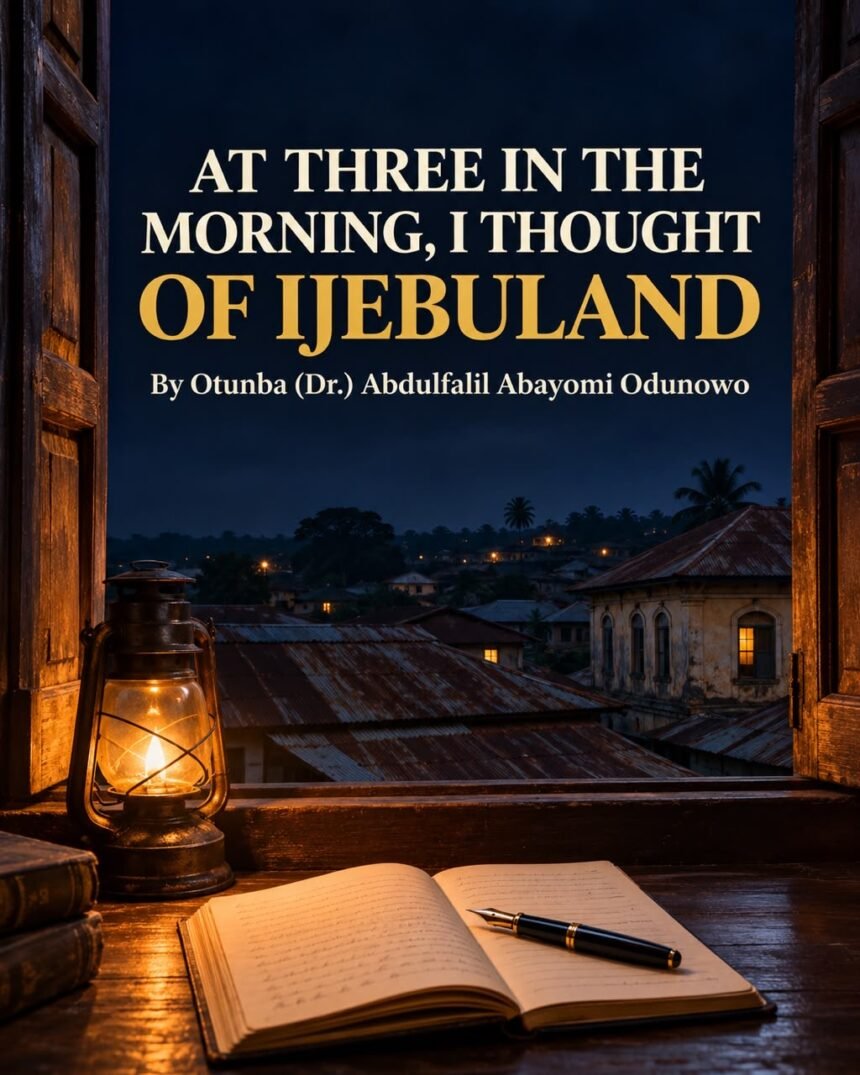
By Otunba (Dr.) Abdulfalil Abayomi Odunowo
At three o’clock this morning, the house was quiet—the sort of silence that leaves a man face to face with the burden of his people. I got up, not because sleep had deserted me, but because one question would not let me be: What has become of the Ijebu? When our children one day read the story of this moment, what will they say about us?
There was a time when a man among our people was judged by the value of his word. Some things could not be bought from him with money. Honour was never treated as something for sale. That is still the story we pass down to our children about the blood in their veins. But can we honestly still say that story belongs to us?
The Ijebu were not a people given to idle self-praise. Centuries ago, they built Sungbo’s Eredo, an immense network of walls and ditches that stands among the largest man-made earthen works in Africa, with more earth moved than in the Great Pyramid of Giza. They established a kingdom whose capital was known to Portuguese sailors in the early 1500s as Geebu, a great city encircled by a deep ditch and governed by an Awujale whose authority extended well beyond its borders. With discipline and order, they controlled the crucial trade route between the Lagos lagoon and the Yoruba interior.
Their age-grade system, the Regberegbe, gave community life a structure whose influence remains with us. When the British expedition of 1892 moved to destroy their commercial independence, the Ijebu did not vanish; they adjusted. They redirected their famed commercial instinct into modern enterprise and produced pioneers in banking, industry, and education. Founded in 1913, Ijebu-Ode Grammar School became one of the region’s earliest secondary schools and sent generations into law, medicine, public service, and commerce. From the long reign of Oba Sikiru Kayode Adetona to the industrial vision of men such as Adeola Odutola and Subomi Balogun, this history is more than nostalgia. It remains a living legacy of order, aspiration, and integrity.
Yet for the past thirty days, a darker question has troubled my sleep. Some now murmur that Ijebuland no longer has anyone who can become governor of Ogun State. I look at the sons and daughters we celebrate in business, the professions, and public life, and I know ability is not the problem. The more difficult question is whether we still have the patience and shared resolve to build real support across the state for a capable candidate—especially when doing so requires some among us to put aside personal ambition for the greater good.
Even worse is what people say when they think no Ijebu ear is near. I have heard the claim that the Ijebu have already been bought. That once money appears on the table, an Ijebu man stops asking what serves his people and begins calculating what serves himself. Some go further and say we would even sell our honour if the price were high enough.
That kind of talk insults every Ijebu man or woman who has honoured a difficult promise at personal cost. It also confronts those who say they speak on our behalf. When you walk into a room bearing the mandate of a community, whose interest do you protect when a private offer is placed before you? If you agree to arrangements that will shape the future of the rest of us, can you come back home, stand before your people, and state plainly what was agreed and why?
I have also heard those who argue that the proposed state must not carry the simple, historic name Ijebu State unless their own preferred name is added. My position has not changed. I support the creation of Ijebu State, with its capital in Ijebu-Ode. Our Remo neighbours have every right to state their position clearly, and we must be confident enough to state ours with equal frankness. Anyone proposing a different name or a different capital should place that proposal before the people whose future is at stake. They deserve to hear it before anyone claims the authority to consent on their behalf.
What will become of Ijebuland if the only loyalty anyone can rely on from us is loyalty to party? Consider the young graduate whose parents gave up everything to educate her and who now seeks nothing more than a fair opportunity at a job for which she is qualified. Think of the towns where just one factory could give hundreds of young people reason to build their lives near home instead of being driven to scatter elsewhere. We must be ready to ask our leaders—including those in our own parties—where the promised investments are, how opportunities are distributed, and what they have truly delivered since they last came asking for our votes.
We are under test once more. Some already say that a few people will settle their personal interests behind closed doors and then return to tell us the matter has been concluded. Those who speak for Ijebuland can answer that suspicion only by telling us openly what is being discussed, whose authority they represent, and what commitments, if any, they have entered into in our name. And those of us who expect courage from them must also be willing to ask difficult questions, even when the person to be questioned is a friend, a benefactor, or a leader within our own party.
Years from now, an Ijebu child will open a book or a newspaper and ask what we did while the chance to speak for their future was still ours. That was the question that drew me from my bed at three in the morning. I asked it of myself first. Now I ask it of every son and daughter of this land.
The walls of Sungbo’s Eredo are still there in the earth. The trading spirit that once governed the trade routes still runs through our blood. The honour that once made a man’s word sufficient to settle a matter has not yet been lost beyond recall. But honour does not pass automatically from one generation to the next. It has to be chosen, defended, and handed on.
What will we choose?
Otunba (Dr.) Abdulfalil Abayomi Odunowo
Convener,
Ijebu Lokan fun Itesiwaju Ijebu Movement