By Ibrahim Bunu
Email: ibrahimbunu2520@gmail.com
Introduction: The Question Few Nigerians Are Asking
History rarely announces itself with a dramatic declaration. More often, it advances quietly—through executive decisions, classified agreements, military cooperation, and official silence.
One of the most consequential questions facing Nigeria today is not whether the United States assisted Nigeria against terrorism. That much is publicly acknowledged.
The more important question is this:
What exactly was agreed between Nigeria and the United States, and who approved it?
When General Dagvin Anderson of the United States Africa Command (AFRICOM) publicly stated in July 2026 that America had withdrawn much of the force deployed to Nigeria, many Nigerians heard the announcement for the first time—not from Abuja, but from a foreign military conference.
That single moment raised more questions than it answered.
If foreign troops entered Nigeria under an agreement with the Nigerian government, why was their departure not announced by Nigerian authorities?
If American forces had completed their mission, what would have remained after they left?
And if intelligence sharing, surveillance flights, logistical cooperation, and infrastructure negotiations continue, did the deployment truly end—or merely change form?
These questions deserve sober analysis rather than partisan rhetoric.
Chapter One: Nigeria’s Long Resistance to Foreign Military Presence
For nearly two decades, successive Nigerian governments resisted hosting permanent American military facilities.
Following the establishment of AFRICOM in 2007, several African countries accepted varying degrees of American military cooperation.
Nigeria consistently maintained that its sovereignty required limiting foreign military footprints on Nigerian soil.
This position rested on several considerations:
* protection of national sovereignty;
* domestic political sensitivity;
* regional leadership within West Africa;
* constitutional accountability;
* concerns that permanent foreign bases could compromise strategic independence.
For years, this policy appeared remarkably consistent.
Then events moved rapidly.
Chapter Two: A Timeline of Escalation
Late 2025 marked a noticeable shift in U.S.–Nigeria security engagement.
Public reporting indicated increased American concern over deteriorating security conditions in northern Nigeria, particularly the activities of ISIS-linked groups and other armed organizations.
On Christmas Day 2025, U.S. airstrikes targeting militant camps in northeastern Nigeria were publicly acknowledged by Nigerian authorities as part of counterterrorism cooperation.
This represented a significant milestone because it was one of the clearest publicly acknowledged examples of direct U.S. kinetic action in support of Nigerian security operations.
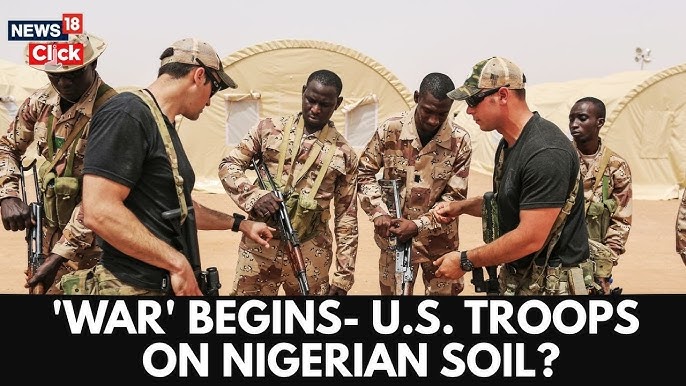
Several weeks later, reports emerged that American military personnel had deployed into northeastern Nigeria.
According to Nigerian officials, their mandate included:
* intelligence sharing;
* logistics;
* operational planning;
* military education;
* technical assistance.
The official description emphasized support rather than independent combat operations.
Chapter Three: The Promise and the Reality
Military partnerships often evolve.
A deployment initially described as advisory may expand if battlefield realities change.
Reports concerning operations in the Lake Chad Basin during May 2026 suggested that U.S. personnel participated alongside Nigerian forces in counterterrorism activities against ISIS-affiliated militants.
Public reporting on the precise role of American personnel varied.
Some reports described direct participation by U.S. special operations forces, while official Nigerian statements emphasized joint operations without fully detailing the operational roles of each partner.
This distinction matters.
If foreign troops moved beyond advisory functions into combat, then the legal and political implications would become significantly greater.
Without publication of the governing agreement, citizens cannot independently assess the exact scope of authorization.
Chapter Four: The Withdrawal Announcement That Raised More Questions
On 2 July 2026, AFRICOM Commander General Dagvin Anderson announced that much of the U.S. force sent to Nigeria had been withdrawn.
Notably, publicly available reporting indicated that:
* No troop numbers were released;
* No deployment locations were identified;
* No withdrawal schedule was disclosed;
* Nigerian authorities did not issue a parallel public announcement explaining the withdrawal.
Silence does not necessarily imply wrongdoing.
Military operations frequently involve operational security.
However, prolonged silence regarding major foreign military deployments can weaken public confidence and invite speculation.
Transparency is particularly important in constitutional democracies.
Chapter Five: Did America Leave?
The answer depends entirely on what one means by “leave.”
Visible military personnel and long-term strategic engagement are not the same thing.
Modern military influence increasingly depends upon:
* satellite intelligence;
* aerial surveillance;
* cyber cooperation;
* logistics;
* communications;
* intelligence fusion;
* contractor support.
Even after troop rotations conclude, these capabilities often remain.
Reports have suggested continued intelligence cooperation between Nigerian and American agencies.
Other reporting has discussed surveillance aircraft operating in support of regional security missions.
There have also been discussions in media reports about possible requests for logistical facilities related to drone operations.
At the time of writing, however, there is no publicly available evidence that Nigeria has approved a permanent U.S. military base or drone-refueling facility.
That distinction is essential.
Discussion of possible infrastructure should not be presented as confirmation that such facilities exist.
Chapter Six: Constitutional Questions
The Nigerian Constitution vests significant authority over defense and foreign affairs in the executive branch.
Nevertheless, democratic governance also depends upon accountability.
Where foreign military cooperation involves substantial operational commitments, citizens naturally ask:
* Was the National Assembly informed?
* Was any formal agreement signed?
* Was legislative approval required?
* Were there memoranda of understanding?
* What limits governed foreign personnel?
These questions are constitutional rather than ideological.
They concern oversight rather than opposition.
Chapter Seven: Why Transparency Matters
National security often requires confidentiality.
Operational details cannot always be disclosed.
Yet democratic legitimacy requires that the framework governing foreign military cooperation be understood.
Citizens need not know tactical details.
They should, however, understand:
* who authorized the deployment;
* its legal basis;
* its duration;
* its objectives;
* The mechanisms for oversight.
Without these, public trust may erode even when security cooperation is beneficial.
Chapter Eight: Electoral Timing and Public Perception
The sequence of events unfolded during a politically sensitive period preceding Nigeria’s 2027 general election.
Observers may reasonably debate whether the timing had political implications.
Some analysts argue that visible military successes could strengthen perceptions of government competence.
Others contend that counterterrorism operations were driven primarily by security imperatives rather than electoral calculations.
At present, no public evidence conclusively demonstrates that operational decisions were timed for electoral advantage.
The possibility may be discussed as an analytical hypothesis, but it should not be presented as a fact.
Chapter Nine: Competing Interpretations
Supporters of the cooperation argue:
* high-value terrorist targets were removed;
* intelligence sharing improved;
* Nigerian forces benefited from advanced capabilities;
* Regional security cooperation strengthened.
Critics raise different concerns:
* insufficient transparency;
* uncertain constitutional oversight;
* lack of publicly available agreements;
* potential long-term dependence on foreign intelligence;
* public uncertainty regarding future infrastructure arrangements.
Both perspectives deserve careful consideration.
Chapter Ten: Lessons for Nigeria
This episode highlights broader policy questions that extend beyond one operation.
Nigeria may wish to consider:
* publishing general frameworks for foreign military cooperation without compromising operational security;
* strengthening parliamentary oversight of major security agreements;
* clearly communicating the objectives and limits of foreign deployments;
* ensuring periodic public reporting on strategic partnerships;
* maintaining a balance between international cooperation and national sovereignty.
These measures could reinforce both democratic accountability and public confidence.
Conclusion
Whether the 2026 deployment should be viewed as a temporary counterterrorism mission or the beginning of a deeper strategic relationship depends on evidence that has not yet been fully disclosed.
What is established is that Nigeria and the United States expanded security cooperation against shared terrorist threats.
What remains uncertain are the precise legal arrangements, the scope of operational authority granted to U.S. personnel, and the future trajectory of that partnership.
The most enduring issue is therefore not simply whether American troops came or left.
It is whether Nigerians possess sufficient information to understand how decisions affecting their sovereignty were made.
In constitutional democracies, security and transparency should reinforce—not undermine—one another.
The debate should therefore move beyond emotion and ideology toward evidence, accountability, and informed public discussion.