Before the Borders, There Were the Kel Tamajaq
By Jennyfer Ambe DrPH
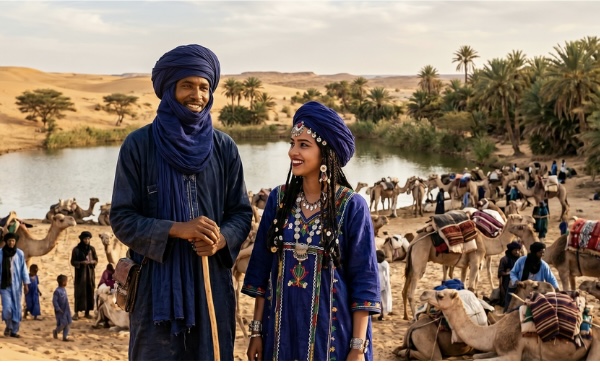
I write this as a child of the Sahel, someone who grew up watching the Amazigh people and their camel caravans move along routes that were ancient long before the borders of any modern nation existed. When I say Sahel, I do not mean the crisis zone the headlines have made of it. I mean an ancient civilizational corridor, stretching from the Atlantic to the Horn of Africa, that nurtured kingdoms, trade routes, languages, and peoples long before any outside power thought to name it “a problem”. Let me begin with the people at the heart of this story. The Amazigh; known to the outside world as part of the Berber people, otherwise known as Toureg. They are the indigenous inhabitants of North/ North-West Africa, one of the oldest continuous civilizations on earth. Their name for themselves, Amazigh, means “free people,” and across the vast sweep of the Sahara and the Sahel, they have lived that name for millennia. They are found today from the Atlantic coast of Morocco to the mountains of Libya, from the highlands of Algeria to the desert corridors of Mali and Niger. But there is one branch of this extraordinary family that is almost never placed where it truly belongs, in West Africa. Let me be clear about the name first: who the world calls “Tuareg” is an Arabic label meaning “the abandoned of God”…a name imposed from outside. They call themselves the Kel Tamajaq in Niger, this means, “the people who speak Tamajaq”. Proud, free, and self-defined. I will honour that here.
I would like to acknowledge Okoi Obono-Obla’s excellent essay on the Amazigh people, published here on Chat Afrik. It is a wonderful contribution that I want to build upon, because there is a dimension of this story that deserves deeper exploration. The Amazigh people are routinely framed as a North African and I want to reframe that, because geographically, historically, and culturally, they are equally West African. The reason this is so rarely said aloud comes down, in my view, to colorism. Because the Amazigh are lighter-skinned, the colonial gaze and its intellectual descendants, have consistently grouped them with North Africa and away from the darker-skinned peoples of the Sahel and West Africa. The borders drawn at the Berlin Conference of 1885 did not see nations that existed before them, and they certainly cannot contain a people whose identity was defined not by ethnicity as “race” / colour, but by language, culture, and the freedom of movement across an open land. That omission is not unusual. It is, in fact, symptomatic of a much deeper problem: the habit of reading African history backwards through the distorting lens of colonial borders, rather than forwards from the civilizations that actually shaped this land.

Let us begin where history begins. In antiquity, the Amazigh and specifically, for this article, I am writing about the Kel Tamajaq people, moved southward from the Tafilalt region into the Sahel under their founding queen Tin Hinan, believed to have lived between the 4th and 5th centuries. This was not migration in the modern sense. It was a people moving through their own world, reading the land by stars and seasons, answering to no modern border because none yet existed. From the seventh century onward, following the Arab conquest of the Maghreb, they began a continuous southwestward movement, arriving in the region we now call Niger around the eleventh century onward. By the end of the 1300s, Kel Tamajaq tribes had established themselves as far south as what we now call northern Nigeria. Notice the phrasing I am forced to use, “what we now call.” That is precisely the problem. There was no Nigerian border in the 1300s. There was only land, and people who knew it intimately.
The Sultanate of Agadez, founded in 1405, grew into a major political and economic powerhouse controlling vital trans-Saharan trade routes. One of those routes ran directly and uninterrupted into the heart of what is now northern Nigeria. The most important of these arteries ran from Kano northward to Tunis and Tripoli via Agadez, Ghat, and Ghadames. Men from the Aïr region would depart in October or November, trade millet for salt and dates, then travel south to Kano, remaining in the Hausa southlands for five to seven months of the year, returning with millet, utensils, tools, pottery, cloth, and spices. I witnessed this route personally. As a child making the journey by road to Kano, I would see camel caravans moving alongside us, unhurried, purposeful, ancient. They were not crossing into a foreign country. They were doing precisely what their ancestors had done for centuries before them. The road was new. The route was not.
What the colonial period did was both catastrophic and deliberate. With the independence of African nations in the 1960s, the ancient north-south routes were severed by national boundaries, and governments hostile to Kel Tamajaq nationalism made little effort to maintain trans-Saharan trade. Their territory was artificially divided, with large populations assigned by decree to Niger, Mali, Algeria, Libya, and Burkina Faso. Nigeria was never named in that reckoning, yet the Kel Tamajaq were already there, had been there for centuries, and remained. The droughts of 1972 and 1982 that many accounts cite as the origin of their Nigerian presence are a recent footnote in a story that is centuries older. What those droughts did was deepen a settlement that was already ancient. They did not create it.
I am not a historian, I am a witness, a child of the Sahel attempting to document what I have seen and lived, and to offer a “corrective” to the misconceptions that colonial framing has left behind. What I witnessed was the living continuation of one of Africa’s most enduring civilizations… a people whose roots in this land predate every border, every colonial charter, and every nation-state in the region. They are not merely North African. They are Sahelian. They are West African. They are ours, and we are part of them too.
Image generated by AI