

By Adeyemi Ademowo Ph.d
In Nigeria’s contemporary political theatre, what confronts the attentive observer is not merely competition for governance, but a restless choreography of ambition unmoored from ideological conviction. The ongoing leadership debacle within the African Democratic Congress (ADC), the messianic posturing of emergent “coalitions,” and the lingering internal contradictions within the People’s Democratic Party (PDP), exemplified in the tensions surrounding Nyesom Wike and his party contemporaries, collectively reveal a deeper malaise: the evacuation of ideology from Nigerian party politics.
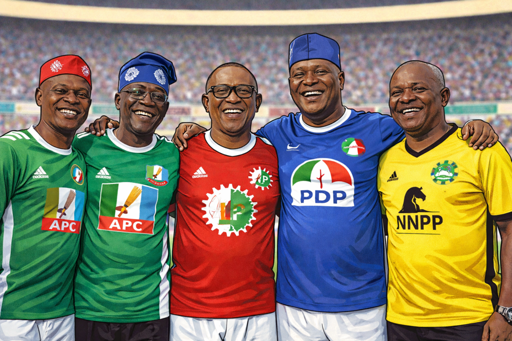
What we are witnessing resembles, in many respects, a season of transfer, of players switching clubs, not for the love of a playing philosophy, but for strategic advantage, visibility and the promise of trophies. In this political transfer market, actors become itinerant figures, moving from one party to another with astonishing ease, unconstrained by doctrine or programmatic commitments. Parties, in turn, function less as ideological platforms and more as electoral vehicles (as mere conduits for capturing state power).
Yet, unlike professional football where clubs often retain distinctive playing identities, Nigerian political parties increasingly blur into nonsensical indistinguishability. The electorate is thus confronted with a perplexing sameness; a homogenized political field where manifesto differences are cosmetic, and where slogans substitute for substance. The consequence is a peculiar paradox: a populace yearning for transformative development, yet compelled to invest hope in a system structurally disinclined to produce it.
From a sociological standpoint, this phenomenon may be worryingly understood as a crisis of political institutionalization. As Samuel P. Huntington argues in his book, “Political Order in Changing Societies” (1968), the central problem in many postcolonial societies is not the absence of political participation, but the weakness of institutions to organize and discipline that participation. Yet, as Claude Ake cautions, in his work “Democracy and Development in AFrica” (1996) this institutional fragility is not ideologically neutral; it is deeply embedded in a political economy where the state becomes an arena for elite accumulation rather than collective development. Nigerian parties, in this sense, have failed to evolve into stable carriers of ideological traditions, whether social democratic, conservative, or progressive. Instead, they are captured by elite networks whose primary objective is access to state resources, reinforcing a cycle in which governance becomes transactional and development is reduced to patronage.
The Yoruba epistemic universe offers a penetrating lens through which this condition may be apprehended. The saying, “ọ̀nà kan ò wọjà” (the marketplace is not reached by a single path), affirms plurality and the legitimacy of diverse routes to collective ends. Yet, such plurality is never a license for aimlessness. Hence the complementary wisdom: “bí a ba ri ẹni to mọ ibi tí ó ń lọ, a kì í jẹ́ kó ṣìna”—when one finds someone who is certain of his or her destination, such is not to be led, or easily led, astray. In the Nigerian political context, however, actors seem to circulate within the marketplace of power without teleology: adrift, improvisational and governed more by the contingencies of opportunity than by any coherent vision of societal transformation.
Even more telling is the saying: “àgùntàn tó bá sọnù, a máa jẹ́ ìjàpá l’ọrẹ́”; a lost sheep is often conditioned to befriend the tortoise. In political terms, actors bereft of ideological grounding become susceptible to opportunistic alliances, often at odds with public interest, even those openly known as “thieves” or homolooters (a term I coined years ago to describe African political gladiators who cant think homosapienly but kleptomaniacly). The so-called coalitions, draped in the rhetoric of rescue and renewal, risk becoming assemblages of convenience rather than communities of shared conviction.
For the masses, this ideological vacuum has profound implications. Development is imagined as a miraculous outcome; as something that will emerge from the mere rotation of elites or the sudden appearance of a “strong” leader or a messiah of a sort. Mbaannu! No! Even comparative political experience suggests otherwise. In countries like the United Kingdom or the United States, while party politics is not without its contradictions, there remains a discernible ideological architecture that shapes governance. The UK Labour Party, for instance, historically aligns with welfare-oriented policies and social democracy, while the Conservative Party emphasises market liberalism and limited government. Similarly, in the United States, the Democratic Party and the Republican Party (despite internal fractures} still operate within recognizable ideological boundaries that inform policy directions on taxation, healthcare, and social justice.
In these contexts, development is not left to chance. charisma or to ethnic biases; it is negotiated through ideological contestation, institutional memory and policy continuity. Governments may change, but the underlying frameworks of economic and social organization remain intelligible. By contrast, the Nigerian political landscape often resembles a theatre of fluid allegiances, where the absence of ideological anchors renders policy direction unstable and development aspirations perpetually deferred.
As the Yoruba would remind us, “ẹnikan kì í gbìn alúbọ́sà kó kà ẹ̀fọ́” (one does not plant onions and expect to harvest vegetables; a system sown with opportunism, ideological emptiness, and elite bargaining cannot yield the fruits of coherent development. The harvest will always mirror the seed. Where there is no philosophy, no clarity of purpose, and no disciplined party structure, development becomes not just delayed, but fundamentally misplaced in expectation.
In the end, the question is not whether coalitions will emerge or parties will realign; they always will. The more pressing question is whether these formations will transcend the logic of power for its own sake and embrace the harder, more demanding work of ideological definition and developmental commitment.
Until then, the masses may continue to wait for a miracle (wey fit no happen) while the structure itself conspires against its arrival.
Mo wí t’ẹ́mi o… ìrè o!
Adeyẹmí Johnson Ademọwọ is a professor of sociocultural anthropology and African studies, department of Sociology, Afe Babalola University, Ado-Ekiti yemiademowo@gmail.com
Advertisement