From Revolution to Relentless Conflict: Iran’s Tumultuous Path from 1978 to 2026
by Okoi Obono-Obla
The Iranian Revolution erupted in 1978, when Islamic clergy, mullahs, students, and anti‑Western interest groups allied to topple the monarchical‑cum‑democratic government of Shah Mohammad Reza Pahlavi. His increasingly pro‑U.S. and Western orientation fueled frustration among the pro‑change movement, paving the way for a Shia‑inspired revolutionary wave that established an Islamic theocracy. Its fervor reverberated across the border into Iraq, then under Saddam Hussein’s Ba’athist Party, which feared the export of radical Shia ideology.
This ideological clash between two neighboring states—both with predominantly Shia populations—soon escalated into war. Iraq launched the first strike by invading Iran, then led by Supreme Leader Ayatollah Ruhollah Khomeini and President Akbar Hashemi Rafsanjani. Although Iraq initially gained ground, it quickly discovered that Iran was a formidable adversary. The war became a brutal stalemate, lasting eight years and claiming hundreds of thousands of lives. Iran lost between 200,000 and 600,000 soldiers, while Iraq’s losses ranged from 105,000 to 500,000.
Nearly half a century later, in 2026, Iran finds itself embroiled in yet another bloody conflict—this time against the United States and Israel, two of the world’s most advanced militaries. The devastation is likely to surpass that of the Iran‑Iraq war, given the deadly sophistication of modern warfare, artificial intelligence, and drone technology.
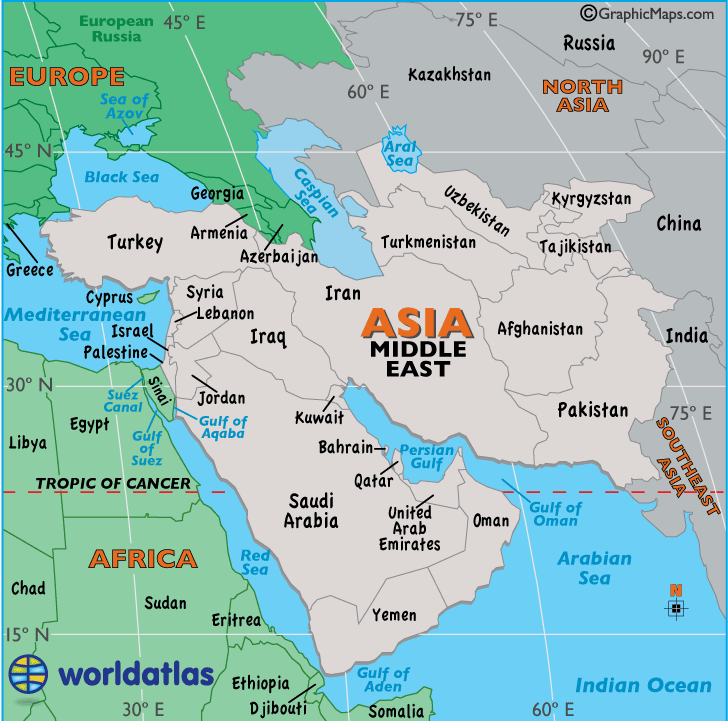
The Sunni Muslims of the Middle East, particularly in the Gulf States such as Oman, Bahrain, Qatar, Kuwait, and Saudi Arabia, have long regarded themselves as custodians of Sunni traditions. They remain deeply uneasy and hostile toward Iran’s radical Shia ideology. Iran’s bellicose rhetoric and foreign policy, coupled with its portrayal of these states as mere havens of U.S. influence, have continuously raised the political temperature in the region. This posture has cast Iran as a warrior state, reminiscent of Japan before the Second World War. Its refusal to recognize Israel and vows to destroy it have fueled its sponsorship of militant groups such as Hamas, the Houthis, and Hezbollah—all united in their resolve to eliminate Israel.
Conclusion
The Iran‑Iraq war of the 1980s remains one of the most destructive conflicts of the late 20th century, and its echoes continue to shape Middle Eastern geopolitics. Today, Iran’s confrontations with the United States, Israel, and its Sunni neighbors highlight the enduring volatility of the region. Whether this ongoing struggle marks the twilight of Iran’s revolutionary project or risks precipitating a wider conflagration—even a Third World War—the consequences for global peace and security could be catastrophic.