
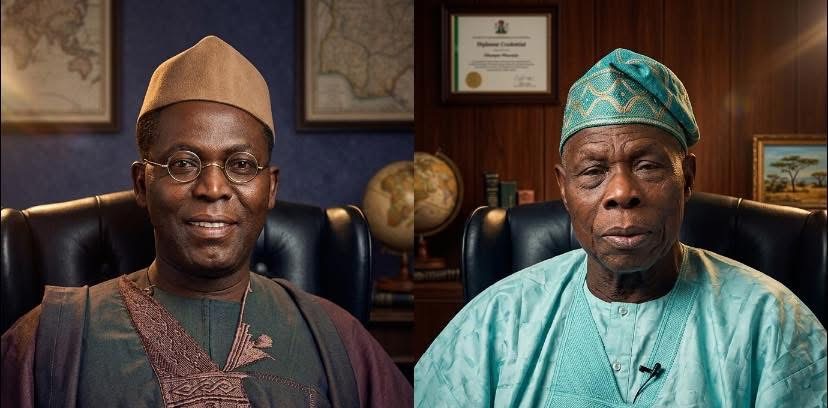

THE WAR OF POWER AND PRINCIPLE: AWOLOWO VS OBASANJO
by Sam Adeoye
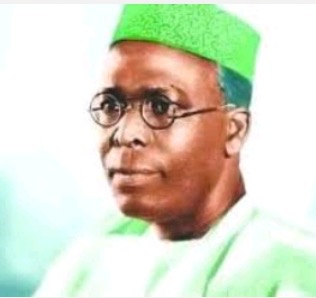
Obafemi Awolowo was not just a politician—he was a system builder trapped in a country that resisted systems. Everything about him was deliberate: his ideas, his policies, his discipline. He believed Nigeria could be structured into greatness through education, economic planning, and accountable governance. To Awolowo, leadership was not about survival—it was about transformation.
Olusegun Obasanjo represented something entirely different. He was a soldier shaped by command, hierarchy, and control. Where Awolowo believed in intellectual persuasion, Obasanjo believed in decisive authority. He was not driven by ideological purity; he was driven by what could be managed, controlled, and sustained.
The clash between these two men was not loud, but it was real. It was not fought with insults—it was fought through influence, positioning, and outcomes.
The defining moment came during Nigeria’s transition from military rule to civilian government between 1976 and 1979, when Obasanjo, as Head of State, controlled the direction of that transition. This period was not just about handing over power—it was about determining who would inherit it and under what conditions.
Awolowo stood ready. He had the experience, the national presence, and a clear blueprint for governance. But Nigeria was not operating on merit alone. It was operating within a power structure that favored continuity over disruption.
Obasanjo supervised a transition that eventually produced Shehu Shagari as President. That outcome was not accidental—it reflected the deeper political alignment of the time. It showed clearly that the system in place was not inclined toward Awolowo’s brand of disciplined, reform-driven leadership.
This is where the real battle existed.
Awolowo represented change—structured, disciplined, and uncompromising. His ideas threatened the informal networks that thrived on patronage and flexibility. He was not a man you could easily negotiate with behind closed doors. His loyalty was to policy, not politics.
Obasanjo, on the other hand, operated within the realities of power. Whether by strategy or instinct, he aligned with a process that preserved the existing balance rather than disrupt it. His approach ensured stability—but it also maintained a system that resisted deep reform.
This is the hard truth: power rarely rewards those who seek to change its foundation.
As Niccolò Machiavelli observed, “There is nothing more difficult to take in hand… than to take the lead in the introduction of a new order of things.” Awolowo attempted to introduce a new order. Obasanjo managed the old one.
And in that contest, management defeated reform.
Awolowo contested for power with clarity but lacked the kind of broad political alliances that could override the establishment. Obasanjo, positioned at the center of that establishment, ensured that the transition favored a candidate and structure that would not destabilize the system.
The result was clear:
Awolowo remained outside the presidency, not because he lacked capacity, but because he stood against a system that was not ready to accommodate his kind of leadership.
Obasanjo retained influence, not necessarily because he was more visionary, but because he understood how to operate within the system without threatening its core.
Scripture says in Daniel 2:21, “He changes times and seasons; He removes kings and raises up kings.” Yet, within those divine movements, human systems still play their part. Decisions are made. Alignments are formed. Outcomes are shaped.
This is not just about two men—it is about two philosophies.
One believed Nigeria needed restructuring from the foundation.
The other ensured Nigeria continued within a manageable framework.
One pushed for transformation.
The other secured continuity.
And Nigeria moved in the direction of continuity.
That decision has echoed through generations.
Because when a nation consistently chooses what is manageable over what is necessary, it does not collapse immediately—it slowly decays.
This is the political reality many avoid.
Awolowo did not lose because he was wrong.
He lost because he was ahead of a system that was not ready to change.
Obasanjo did not win because he was perfect.
He prevailed because he understood how power protects itself.
Until Nigeria confronts this truth, it will continue to recycle leadership struggles—different faces, same outcome.
Sam Adeoye
Pastoral & Psychological Counselor
Mind & Spirit Transformation Coach












Leave a comment