
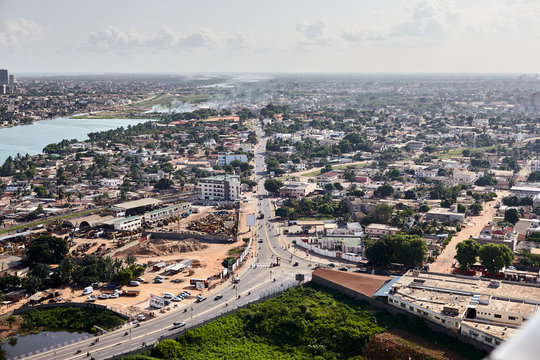

My Visit to Lomé, Togo:
I recently visited Lomé, Togo—a small country in West Africa with a population of about nine million people—and had the golden opportunity to experience firsthand what life there is like. I flew to Lomé from Abuja, a journey of just fifty‑five minutes. As we began descending, the aircraft stopped briefly at Cotonou, the capital of Benin, located at Nigeria’s southwestern boundary, to drop off and pick up passengers. From there, it was only a 25‑minute flight to Lomé, cruising at 12,000 feet above the ground until we touched down at the Gnassingbé Eyadéma International Airport, named after President Gnassingbé Eyadéma.
Eyadéma, who in 1967 toppled Togo’s first president, Sylvanus Olympio, maintained an iron grip on the country for 38 years until his death in 2005 while en route to France for medical treatment. He was succeeded by his son, Faure Gnassingbé, who has remained in power to this day. Thus, Togo has been under the leadership of one family since 1967—a span of nearly 59 years. Several generations have grown up in Togo knowing no other ruling family.
One of the first things I noticed in Lomé, a beautiful city on the Atlantic coast, was that apart from the main roads, most adjoining inner streets are unpaved. This reflects the poverty and poor governance the country has endured in its nearly 65 years of independence. Historically, Togo was handed over to Germany at the Berlin Conference of 1884–1885, when European powers partitioned Africa into 54 countries without regard for history or anthropology. Ethnic groups were arbitrarily divided, and this is evident in Togo, where the Ewe people are also found in Ghana and Côte d’Ivoire.
It is believed that the Ewe people originated from the Yoruba ethnic group of southwestern Nigeria and migrated to the present Republic of Togo around the 16th century.
Yet, despite these challenges, I observed a strong sense of law and order in Togo. Motorcyclists and their passengers consistently wear crash helmets, mindful of their safety—unlike in Nigeria, where such precautions are often ignored. Traffic police officers, armed with whistles, enforce rules with stern discipline. At intersections, motorists dare not move until a whistle is blown, or they face immediate consequences. As in most Nigerian cities, motorcycles are the most common means of commuting in Togo.
Another striking observation was that the cost of living in Togo is relatively high compared to Nigeria. This is evident in the prices of food in restaurants, bottled goods, and hotel rates. While we are often quick to criticize Nigeria and portray it as the worst country on earth, my visit to Togo—which is just nine hours’ drive from Idi‑Iroko in Ogun State—demonstrated to me that Nigeria is far ahead in many respects, even though both countries gained independence from their colonial masters in 1960.
I also noticed that the Togolese people are generally quiet, easy‑going, and peace‑loving, unlike the more aggressive and unrelenting spirit often seen in Nigerians, who confront life squarely and resolutely, determined to conquer it despite its difficulties. Togo, with its beautiful Atlantic shores, needs change, prosperity, and foreign investment to transform its coastline into bustling tourist havens comparable to Dubai.
Conclusion:
My journey to Lomé offered me a glimpse into the paradox of Togo: a nation rich in culture, discipline, and resilience, yet burdened by decades of political continuity and economic challenges. It reminded me that while Nigeria has its flaws, it has made strides that place it ahead of some of its neighbors. Travel, indeed, opens our eyes to realities we might otherwise overlook, and my visit to Togo was both enlightening and humbling.















Leave a comment